
Independent, evidence based research shows that EasyPeasy significantly improves parent engagement and children’s early developmental outcomes. We recently received a request from a Practitioner asking us to collate articles and research about the benefits of EasyPeasy in one place. If research is what you’re interested in, then look no further!

Striving to ensure that EasyPeasy delivers impact we are committed committed to measuring our impact via academic research, surveys and data and analytics.
Academic Research
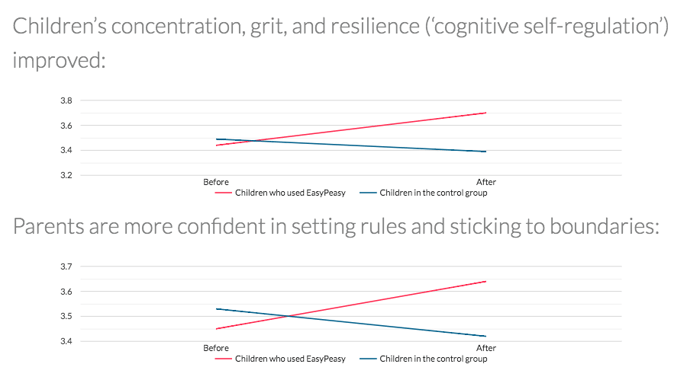
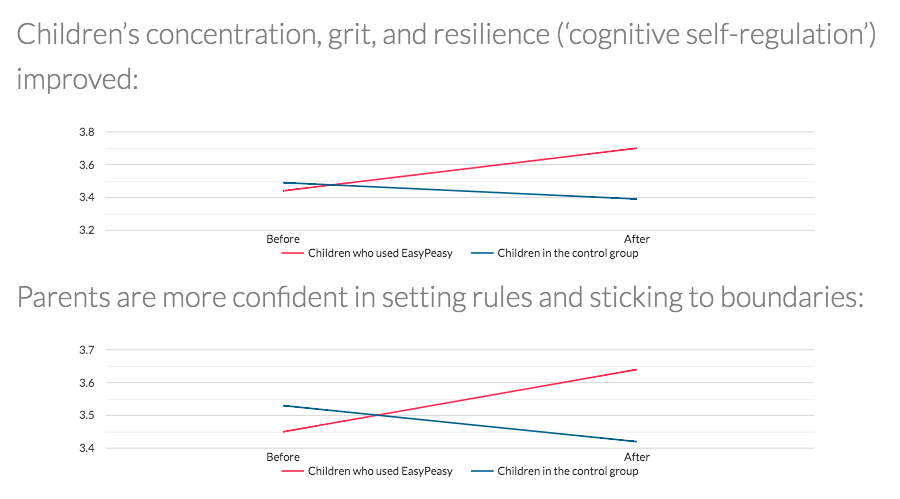
EasyPeasy has been independently evaluated in two rigorous randomised control trials by researchers at the . These were carried out in partnership with , , and . Both of these studies found that EasyPeasy has a positive effect on children’s social and emotional development and parents’ engagement. In the Bournemouth trial, these significant effects were observed after 18 weeks. In the Newham study the same significant effects were observed after only 10 weeks.
Parents in both of these RCTs were split into two groups. One group -the control group- received business as usual treatment and the second group - the intervention group - received EasyPeasy for 20 weeks. During these 20 weeks parents were sent weekly game ideas to play with their children, modelled by real families and accompanied by tips and guidance.
EasyPeasy’s Theory of Change
EasyPeasy’s theory of change sheds light on how EasyPeasy’s service design helps to bring about this impact. Parenting style highly influences children’s early development, which goes on to influence learning in the classroom environment. If parents set consistent boundaries and expectations, over time children internalise this and develop an ability to regulate their own behaviour independently, to persist with tasks, and enjoy challenges, rather than shrink away from them. With EasyPeasy, parents set out clear rules and boundaries in the positive and fun context of games. Over time, these approaches influence parenting style more generally, beyond the games themselves and into other aspects of home life (e.g. regular bedtimes, meal times, and expectation setting).
Why is this so important?
By the time children reach their first day of school, half are not ready to learn because they haven’t developed basic skills at home. There is already a huge gap in language and communication, self-control, resilience, and concentration between children from different backgrounds. Any problems that children develop in early years continue into school and later life, limiting their potential and causing wider social and economic harm.
We often share The Effective Pre-School, Primary and Secondary Education Project (EPPSE) report with Practitioners during their EasyPeasy training sessions. EPPSE is the basis of a lot of work being done to improve early years provision and the home learning environment as it demonstrates the effect of these on future education attainment outcomes https://www.ucl.ac.uk/ioe/research-projects/2018/oct/effective-pre-school-primary-and-secondary-education-project-eppse
Here, Kathy Sylva speaks passionately about the positive impact of EasyPeasy stating that EasyPeasy “increased the school readiness of children” by helping them to develop “grit” and the skills required to persist with tasks
Families in these trials were recruited from children’s centres in disadvantaged neighbourhoods and came from a range of different communities. In Bournemouth participant families were predominantly native English speakers and in the Newham trial a high percentage of participants were families who speak English as an Additional Language (EAL). The replication of findings across these two very different communities suggests EasyPeasy’s impact will be consistent in whatever community it is delivered. For more information on the importance of this replication read our published on the Sutton Trust website.
Overview of EasyPeasy’s impact
Bournemouth trial with The Sutton Trust and the University of Oxford (2016): An RCT was carried out in 8 children’s centres involving 150 parents in Bournemouth with the aim of assessing the effects of the EasyPeasy’s digital parenting intervention on parents and children. There was a significant effect of the intervention on: parents’ self-efficacy regarding discipline and boundaries, and parent-reported child cognitive self-regulation.
Newham trial with The Sutton Trust and the University of Oxford (2018): Similar to the above RCT, 302 families from different children’s centres in Newham received weekly SMS messages and game ideas. Positive effect findings on parents’ self-efficacy and children’s cognitive self-regulations were replicated.
The Minister for Children and Families, Nadhim Zahawi saw EasyPeasy in action in Luton and praised EasyPeasy for using technology in a positive way to improve the home learning environment, whilst giving evidence to the House of Commons Science & Technology Committee.
EasyPeasy’s commitment to ongoing impact
England-wide trial with the Education Endowment Foundation (EEF) and the Centre for Monitoring and Evaluation (CEM) at the University of Durham: The EEF and CEM are conducting a large-scale, two arm RCT across 210 early years settings to examine the impact of EasyPeasy’s digital intervention on children’s language and communication outcomes.
Thanks to the support of investors, philanthropy and paying customers, EasyPeasy is currently used by more than 30,000 families with EasyPeasy, delivered through over 400 early years settings and trained over 800 early years practitioners.
